One of the most persistent and unfortunately divisive myths is the idea that Shias have a different Quran. This misconception has been used for centuries to create unnecessary barriers between Muslim brothers and sisters. In this scholarly analysis, we will address this myth directly by looking at the definitive Shia stance backed by the Quran itself and the consensus of our leading jurists (Marja's).
We believe it is vital to clear the air so that all Muslims can focus on what truly matters: learning, reciting, and implementing the words of Allah (SWT) in their lives.
The Definitive Shia Belief
The official position of the Shia school of thought—from the time of our first Imam, Ali (AS), to our present-day Grand Ayatollahs—is that the Holy Quran we have today is the exact same Quran that was revealed to the Holy Prophet Muhammad (SAWA). It is complete, preserved, and free from any distortion or change (Tahreef).
"Indeed, Allah desires to repel all impurity from you, O people of the Household, and to purify you with a thorough purification."
- Holy Quran, Surah Al-Ahzab (33:33).
Every Shia scholar in history has used the divine promise of protection as the cornerstone of our Aqeedah: if Allah (SWT) says He will protect the Quran, then it is impossible for humans to change it. Believing in *Tahreef* (corruption of the text) is considered a departure from mainstream Shia theology.
Addressing the "Mus-haf Fatima" Myth
Where does the confusion come from? Often, it stems from a misunderstanding of the term Mus-haf Fatima. Some mistakenly believe this is a "different Shia Quran." This is entirely incorrect.
In various narrations (Hadiths), it is explained that Lady Fatima (SA) had a book called a Mus-haf. In ancient Arabic, 'Mus-haf' simply means a "collection of bound pages" or a "volume." This book was not a Quran. It did not contain the verses of the Quran, nor did it claim to be a revelation. Instead, it was a compilation of divine inspirations (Ilham) and knowledge regarding future events and historical wisdom given to her by an angel after the Prophet's (SAWA) passing. Our Imams have explicitly stated that this book was *aside* from the Quran and was not part of the revelation.
Are There Differences in Recitation?
Wait, if the text is the same, why do some Shias recite it differently? This is where the world of Tajweed and Qira'at (variant modes of recitation) comes in. Shias and Sunnis both follow the same established style of Qira'at. The most common style used across the entire Muslim world — by both Shias and Sunnis — is the Recitation of Hafs 'an 'Asim.
As we explain in our Essential Guide to Shia Tajweed Rules, the rules of pronunciation and articulation (Makharij) are identical. Any minor differences you may hear in a mosque are purely due to regional dialects or individual mastery of Tajweed, not a difference in the actual written words of Allah.
Unity in the Words of Allah
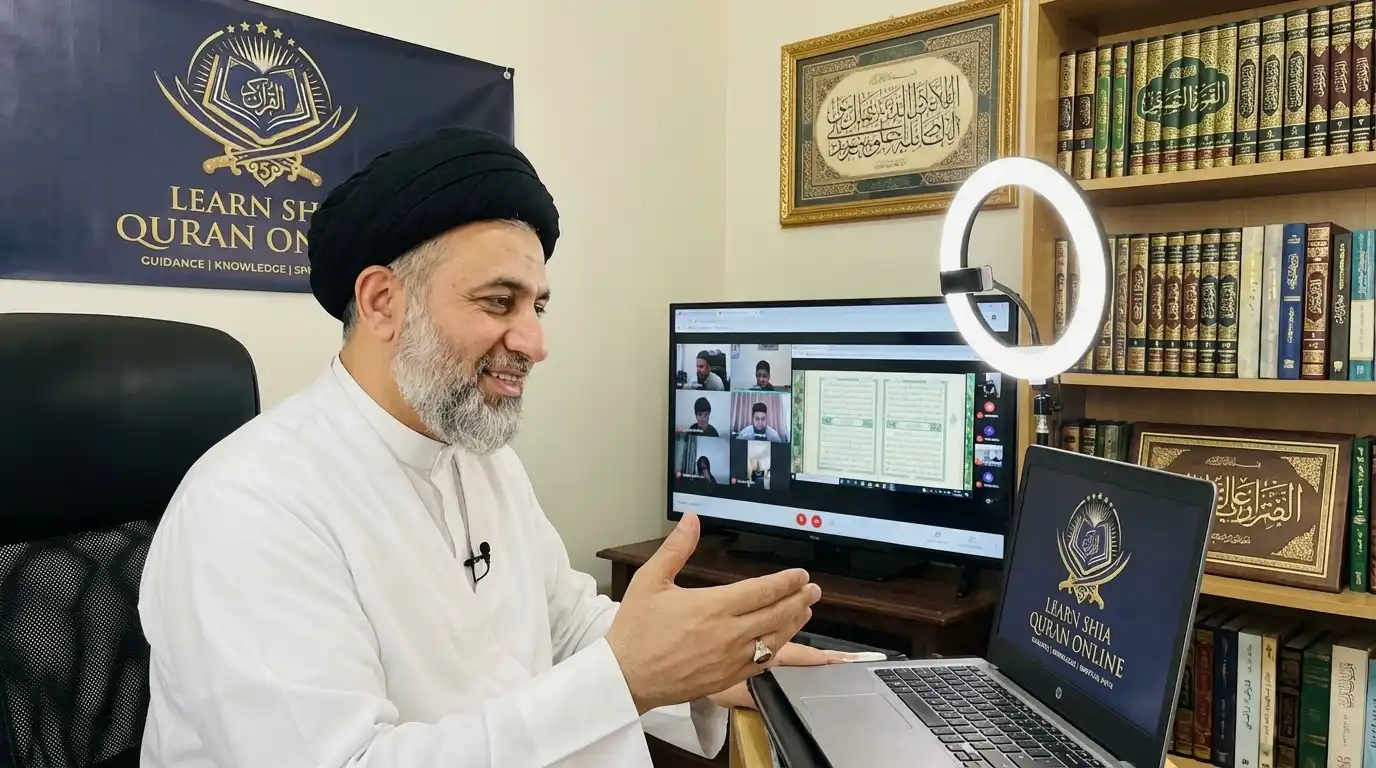
At Learn Shia Quran Academy, we teach our students from the exactly same Quran found in Makkah, Cairo, London, or Najaf. We believe the Quran is the ultimate point of unity for all Muslims.
If you would like to master the recitation of this divine book correctly, we invite you to explore our Shia Tajweed Course Online. We offer personalized, one-on-one sessions for both children and adults to ensure you are reciting every syllable with the precision it deserves.